 Wildlife
of Costa Rica
Brown-throated Three-toed Sloth
Sloths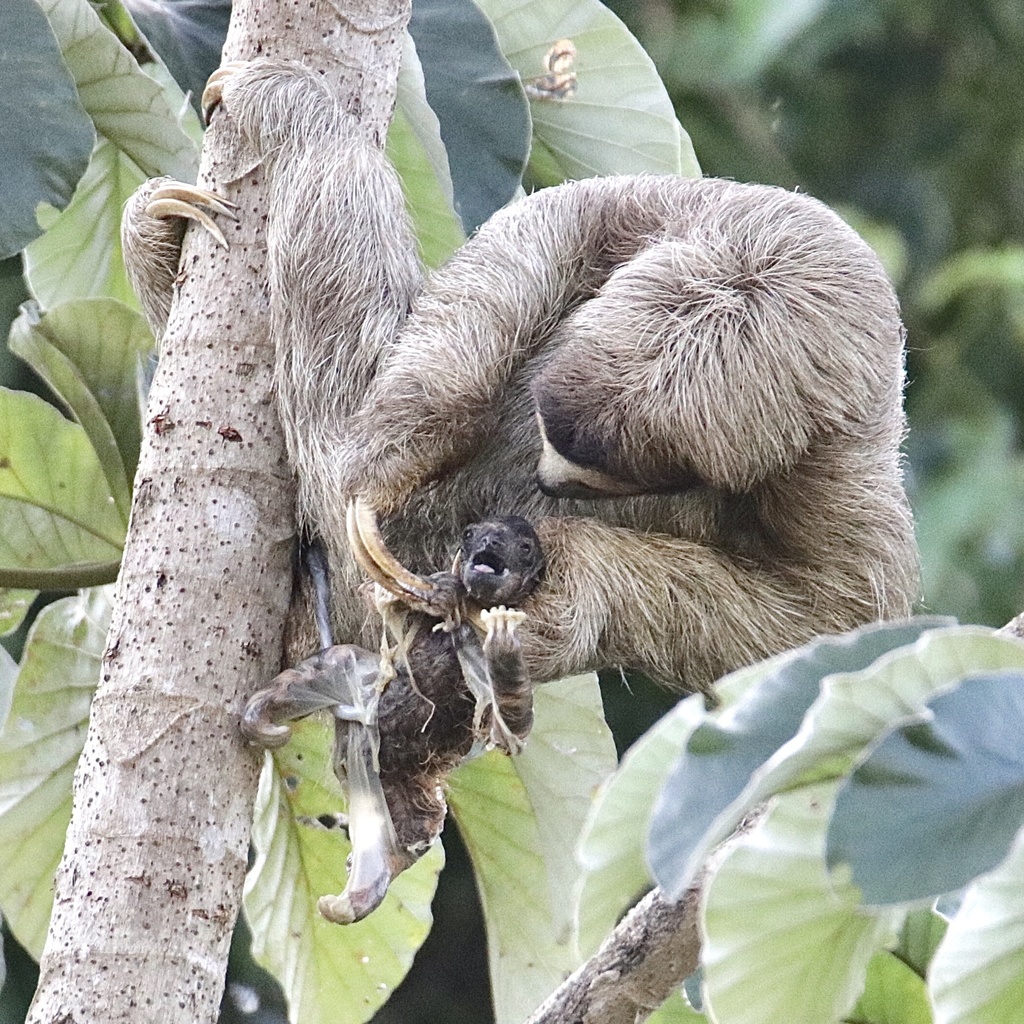
Photo: Ragnhild&Neil Crawford from Sweden · CC BY-SA 2.0
Bradypus variegatus
Basic stats
Diet
Leaves, mainly from sun-exposed crowns and liana-covered trees; individuals often rely on a few favoured trees
Habitat
Rainforest, semi-deciduous and dry forest, swamp and disturbed forest from sea level to about 1,200m; canopy dwelling
Range
Honduras through Nicaragua, Costa Rica and Panama into northern and western South America
Litter size
1
Gestation period
About 6 months
Size
Total length 42–80cm; tail 2.5–9cm
Weight
Adults 2.25–6.3kg
The brown-throated sloth is the most widespread and common of the three-toed sloths. It has three long curved claws on every foot, a rounded head with a blunt nose, and inconspicuous ears. The coat is grey-brown to beige with darker brown fur on the throat, forehead and sides of the face, a pale face with a dark stripe through each eye, and in males a black patch between the shoulders. Algae living in cracks in the coarse guard hairs often tint the fur green (Wikipedia, general species account).
Sloths of this species sleep 15–18 hours a day and may be active by day or night. Individuals move about 40m on an average day and are often found in the same tree. About once a week they climb down to the ground to defecate, digging a shallow hole with the vestigial tail, a habit linked to the moths and algae that live in the fur. Studies in Costa Rica found them strongly dependent on intact forest and on a few tree species, including Cecropia, and that only about a quarter of resident adult males sired offspring (GBIF species profile, Handbook of the Mammals of the World).
Where its range overlaps Hoffmann's two-toed sloth, the three-toed sloth tends to be smaller and more numerous, and more active by day. It also swims well. On this guide it is a target species of Tortuguero, La Selva, Cahuita, Arenal, Manuel Antonio and the Osa Peninsula.
Quick answers
- What does the Brown-throated Three-toed Sloth eat?
- Leaves, mainly from sun-exposed crowns and liana-covered trees; individuals often rely on a few favoured trees
- What habitat does the Brown-throated Three-toed Sloth live in?
- Rainforest, semi-deciduous and dry forest, swamp and disturbed forest from sea level to about 1,200m; canopy dwelling
- Where is the Brown-throated Three-toed Sloth found?
- Honduras through Nicaragua, Costa Rica and Panama into northern and western South America
- What is the litter size of the Brown-throated Three-toed Sloth?
- 1
- How long is the gestation period of the Brown-throated Three-toed Sloth?
- About 6 months
- How big is the Brown-throated Three-toed Sloth?
- Total length 42–80cm; tail 2.5–9cm
- How much does the Brown-throated Three-toed Sloth weigh?
- Adults 2.25–6.3kg