 Wildlife
of Costa Rica
Mantled Howler
Monkeys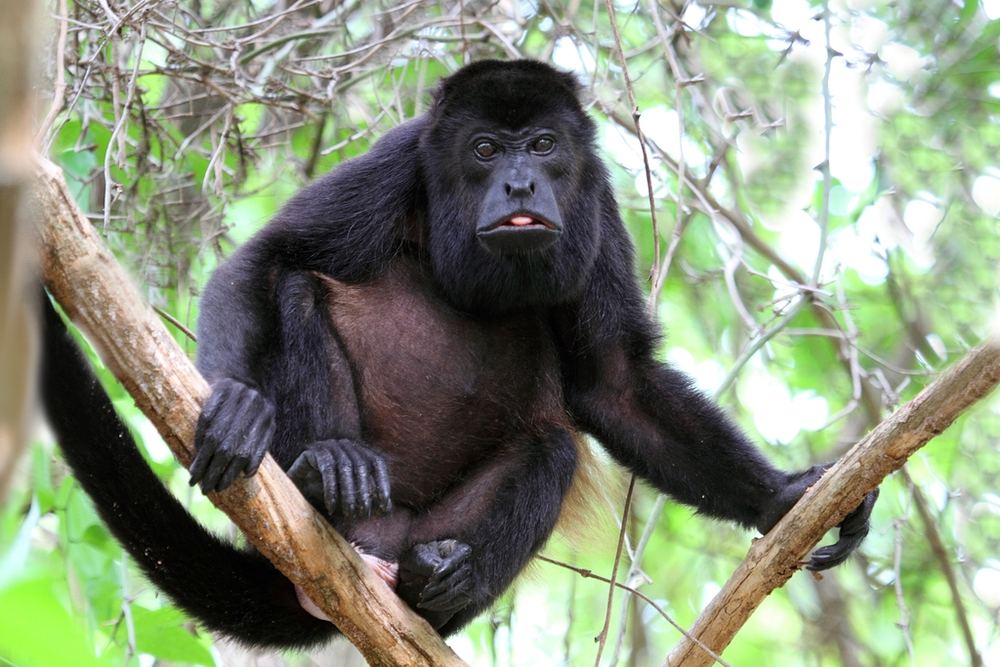
Photo: Cephas · CC BY-SA
Alouatta palliata
Basic stats
Diet
Mostly leaves, with fruit; the only Central American monkey that eats large quantities of leaves
Habitat
Primary and secondary rainforest from sea level to about 2,500m, plus riparian and dry lowland forest, mangrove and coffee plantations; prefers the upper canopy
Range
Southern Mexico through Central America, and the Pacific side of Colombia, Ecuador and north-west Peru
Litter size
1
Gestation period
About 186 days
Size
Head and body 46–63cm; prehensile tail 55–70cm
Weight
Males 4.5–9.8kg; females 3.1–7.6kg
The mantled howler is one of the largest Central American monkeys, and one of the most often seen and heard. It is mostly black, with a fringe of long yellow to golden-brown guard hairs on the flanks that gives it its name. The prehensile tail is longer than the body, and adult males have a white scrotum. Males have an enlarged hollow hyoid bone beside the vocal cords that amplifies their calls, which carry far through the forest and let groups locate each other without moving or fighting (Wikipedia, general species account; Handbook of the Mammals of the World).
Leaves are hard to digest and low in energy, so a typical day is mostly rest: roughly two thirds to three quarters of the day, with 15–24% feeding and 10–18% travelling. Groups usually have 10–20 members, one to three adult males and five to ten adult females, but some exceed 40. Home ranges overlap and are not exclusively defended; most animals of both sexes leave the group they were born into, so adults are mostly unrelated. The species is an important seed disperser (Wikipedia, general species account; GBIF species profile).
In Costa Rica it is among the most commonly seen and heard primates in national parks such as Manuel Antonio, Corcovado and Monteverde (Wikipedia, general species account). On this guide it is a target species of Tortuguero, Cahuita, Arenal, Cano Negro, Santa Rosa, Rincon de la Vieja, Palo Verde, Carara, Manuel Antonio, Corcovado and Drake Bay.
Quick answers
- What does the Mantled Howler eat?
- Mostly leaves, with fruit; the only Central American monkey that eats large quantities of leaves
- What habitat does the Mantled Howler live in?
- Primary and secondary rainforest from sea level to about 2,500m, plus riparian and dry lowland forest, mangrove and coffee plantations; prefers the upper canopy
- Where is the Mantled Howler found?
- Southern Mexico through Central America, and the Pacific side of Colombia, Ecuador and north-west Peru
- What is the litter size of the Mantled Howler?
- 1
- How long is the gestation period of the Mantled Howler?
- About 186 days
- How big is the Mantled Howler?
- Head and body 46–63cm; prehensile tail 55–70cm
- How much does the Mantled Howler weigh?
- Males 4.5–9.8kg; females 3.1–7.6kg